Fraud Protection
Detect Fake Leads and Form Abuse.
Invisible to real users. Actionable for your team.
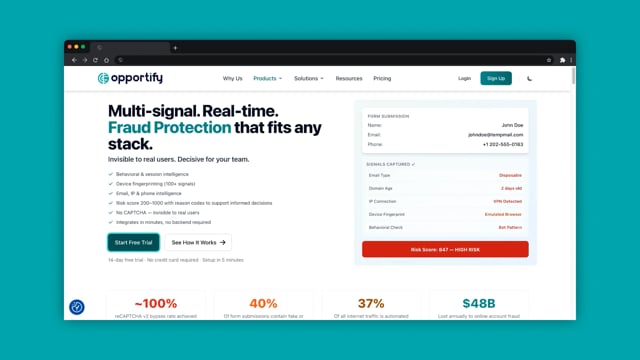
Score every submission across 100+ signals: email, IP, device, behavior, and content. Available as a client-side JS integration for forms or a synchronous server-side API for backends.
14-day free trial · No credit card required · Accessible pricing

Multi-Signal Protection, Zero Friction
Six intelligence signals fused into one risk assessment. Available through the JS client, the server-side API, or both together.
Device Fingerprinting
Browser, device, OS, screen, timezone combined into a stable device identity. Detects automation, headless browsers, emulated environments, and multi-account reuse from the same device.
Behavioral Analytics
Keystroke cadence, mouse movement, scroll patterns, and form interaction timing analyzed in real time. Distinguishes human interaction from automated scripts and click farms.
Email Intelligence
Disposable, role-based, free provider, domain age, MX validity, DNS security posture, and deliverability risk fused into a single email quality signal.
IP & Network Analysis
VPN, proxy, Tor, datacenter, geolocation, ASN, and global blocklists evaluated instantly to surface high-risk connection patterns and geographic anomalies.
Phone Validation
Coming SoonLine type, carrier, VOIP detection, and reachability signal combined to flag disposable, virtual, or high-risk phone numbers across form and API submissions.
Unified Risk Score
200–1000 normalized score with explainable reason codes. Available via synchronous API response or webhook payload. Every signal fused into one actionable assessment.
See Exactly What Every Analysis Returns
Fraud Protection does not return a single yes or no. Each submission comes back as an Explainable Risk Report: one overall score plus a full breakdown of every intelligence source that contributed to it. Here is a real response for a high-risk submission.
- One synchronous call returns every source: email, IP, content, behavior, velocity, and geo
- A single 200–1000 score with explainable reason codes, plus a per-source breakdown
- Behavioral and device signals enrich the score in hybrid mode via the JS client
- Advisory by design: you get the intelligence, your team decides what to act on
14-day free trial. No credit card required. Includes 100 free analyses.
Fraud Protection Response
Email Intelligence850highest
Email Metadata
Delivery Signals
Address Signals
DNS & Authentication
Domain Posture
IP & Network Intelligence850highest
IP Metadata
Geolocation
WHOIS / ASN
- Google LLC
- Mountain View, CA
- 1600 Amphitheatre Parkway
- Leading internet provider
- Mountain View, CA
WHOIS Contacts
- 123 Abuse St, Suite 100
- 456 Admin Lane
- 456 Tech Lane
Provider Trust
Blocklist
Content Analysis650high
Behavioral & Session (Hybrid)650high
Velocity650high
Geographic Consistency650high
Two Ways to Integrate
Choose the integration method that fits your architecture. Both methods share the same enrichment pipeline and produce a unified risk score with explainable reason codes.
Form Fraud Protection
Client-side JavaScript integration
Add one script tag to any page with a form. Every submission is intercepted, scored across all intelligence signals, and classified by risk level. Your team reviews results in the dashboard or receives them via webhook.
Best for
- Public web forms and landing pages
- Lead capture and contact forms
- No-code and low-code sites (Webflow, Framer, WordPress)
- Teams that want zero backend changes
Signals analyzed
Behavioral signals included automatically
Fraud Protection API
Server-to-server REST endpoint
Your backend sends submission data and receives a complete risk assessment in the API response. Full backend control: apply your own logic, accept, flag, or reject based on the score. Works for SaaS registrations, mobile apps, and any backend-driven flow.
Best for
- SaaS registration and onboarding flows
- Mobile apps and API-first architectures
- Backend workflows and batch processing
- Teams that own their submission pipeline
Signals analyzed
Behavioral signals available in hybrid mode (deploy JS client alongside API)
Hybrid Mode: Maximum Signal Coverage
Deploy the JS client on your frontend and pass the opportifyToken to your API request. The API resolves the session and incorporates behavioral signals (typing patterns, automation detection, device fingerprinting) into the synchronous risk assessment.
Detect Risk in 4 Simple Steps
Add one snippet. Get explainable risk signals.
Add the Snippet
Paste 3 lines of JavaScript onto your form page. No backend changes, no SDK to configure — done in minutes.
Protect Your Forms
Create a Form Endpoint in the dashboard and point your form to the secure submit URL. The snippet handles everything else automatically.
Review by Risk Level
Every submission arrives pre-scored and classified. Your dashboard shows all submissions segmented by risk — no manual triage needed.
Act on the Score
Route clean, low-risk submissions to HubSpot, Salesforce, Slack, or any webhook receiver. Review, flag, or reject high-risk and suspicious submissions before they reach your CRM — your team stays in control.
Why Fraud Protection
Detect Risk at the First Interaction
Invisible intelligence that protects form submissions, lead entries, and contact requests, designed to minimize friction.
Trust at Every Entry Point
Contact forms, lead forms, trial request forms, newsletter subscriptions — every submission is evaluated before it enters your pipeline, across every channel.
Designed to Minimize User Friction
No CAPTCHA puzzles or challenge flows. Designed to minimize friction while still surfacing strong risk signals.
CAPTCHA Alone Isn’t Enough
Challenge-based defenses are increasingly bypassed by automated solving services and modern automation tooling. Fraud Protection scores behavior and multi-signal context so your team can act without relying on puzzles.
Intelligence, Not Gatekeeping
A 200–1000 risk score with reason codes gives your team the context to decide: review, flag, or allow — you stay in control.
How Fraud Protection Compares
Most fraud tools specialize in one stage or one signal. Fraud Protection unifies pre-onboarding detection across every signal, at accessible pricing. Here is how it lines up against platforms teams commonly evaluate.
| Capability | Fraud Protection | IPQualityScore | SEON | Kount | Sift |
|---|---|---|---|---|---|
Pre-onboarding focus | Scores signups, forms, and leads before they enter your pipeline | Data enrichment APIs | Transaction fraud, AML | Transaction and identity | Post-transaction fraud |
Multi-signal analysis | Email, IP, content, behavior, velocity, and geo in one call | Separate API per signal | Multi-signal, enterprise | Multi-signal, enterprise | Multi-signal, enterprise |
Explainable risk scoring | Normalized 200–1000 score with structured reason codes | 0–100 per API | Module-specific alerts | Proprietary Omniscore | Proprietary score |
Behavioral & device intelligence | Typing cadence, automation detection, device fingerprinting | Device API add-on | Included | Included | Included |
Integrate in minutes | JS snippet, WordPress plugin, or REST API | Multiple integrations | Enterprise onboarding | Weeks to months | Enterprise timeline |
Transparent pricing & free trial | Published volume-based pricing, 14-day trial, no credit card | Per-call, no trial | Enterprise contracts | Contact sales only | Contact sales only |
Built for teams of all sizes | From a single form to high-volume pipelines | Developers | Enterprise focus | Enterprise focus | Enterprise focus |
IPQualityScore is a trademark of IPQualityScore LLC. SEON is a trademark of SEON Technologies Ltd. Kount is a registered trademark of Equifax Inc. Sift is a trademark of Sift Science, Inc. This page is not affiliated with or endorsed by any of these companies. Feature comparisons reflect publicly available information and are subject to change.
Use Cases for Fraud Protection
Detect fraud risk at every entry point, before it costs you.
Sign-Up & Registration Protection
Fake account prevention: Score every sign-up against email, IP, device, and behavioral signals to surface bots, disposable identifiers, and synthetic identities before an account is created.
Trial & referral abuse: Detect repeated sign-ups from the same device or network attempting to exploit free trials, promo credits, and referral offers.
Multi-account fraud: Surface linked identities reusing the same device fingerprint or network to abuse pricing, quotas, or policies.
Ecommerce & Checkout
Fake order filtering: Score guest checkouts and account creations to flag disposable emails, high-risk IPs, and automated order submissions before fulfillment.
Promo & coupon abuse: Catch repeat redemptions and multi-account discount stacking using device fingerprinting and velocity signals.
Chargeback risk reduction: Surface high-risk submissions early so your team can review or hold orders before they turn into disputes.
Lead Form Quality
CRM pollution prevention: Keep your marketing database clean by scoring fake and low-quality lead submissions before they enter your pipeline.
Fake lead filtering: Score submissions from disposable emails, VPNs, and automated form fills so your team focuses on real prospects.
Bot submissions: Detect automated form submissions without adding a CAPTCHA that hurts conversions.
Marketplace Intake Forms
Seller & buyer intake: Score marketplace seller and buyer application forms before entries reach your review pipeline.
Platform integrity: Protect trust and safety by catching synthetic identities in intake form submissions before they enter your pipeline.
Zero friction: Invisible analysis means legitimate users never experience a checkpoint.
Fintech Pre-KYC Screening
Reduce KYC costs: Filter obvious fraud signals before paying for identity verification, reducing unnecessary KYC spend on high-risk and synthetic submissions.
Synthetic identity detection: Catch fabricated identities and VOIP phone numbers before KYC workflows begin.
Risk-based routing: Route high-risk applicants to enhanced review while fast-tracking low-risk users.
SaaS Onboarding & API Signups
Pre-onboarding scoring: Evaluate registrations server-side via the Fraud Protection API before provisioning accounts or workspaces.
Automation detection: Identify scripted signups and headless browsers using behavioral and device intelligence in hybrid mode.
Advisory routing: Use the explainable risk score to allow, review, or challenge based on your own policy. Your team stays in control.
Earn free credits every month.
Display a visible Opportify badge or link on your site and earn cumulative monthly credits for as long as it stays live. No cost, no catch.
- Earn free credits every month across Fraud Protection, Email Insights, and IP Insights
- Keep a visible Opportify badge or link live on a page you control
Free to join. Credits are cumulative while your badge stays live and visible.
Connects to Everything You Already Use
Fraud Protection delivers results via webhooks and native integrations. Route verified leads directly to your CRM and high-risk events to your alerting stack. Pick from 34 pre-configured destinations or connect any webhook-capable tool. The official WordPress plugin is also available for direct deployment. Via Zapier or Make, you unlock thousands more apps with zero code.
Alert Only
Risk level, score & timestamp. Perfect for Slack or Teams.
Form Fields + Risk Summary
Original form data plus risk level, score, and key signals.
Full Fraud Analysis
Complete enrichment — email, IP, phone, message, and full risk breakdown.
Choose the payload format that matches each destination — minimal for alerts, full enrichment for CRM and AI pipelines.
Add your website & create a form endpoint
Register your domain and set up a form endpoint in the dashboard. Takes 2 minutes.
Drop one JS snippet on your page
Paste a single script tag before your form. Runs invisibly — no backend changes, no visitor friction.
Configure your risk thresholds
Choose which risk levels trigger the webhook. Route verified leads (lowest–medium) to your CRM — send high-risk events to alerting or SIEM tools.
Pick a destination and go live
Select a pre-configured preset or paste any custom webhook URL. Choose your payload format and ship in minutes.
Launch Fraud Protection on WordPress in minutes
Install the official WordPress plugin to score submissions across 100+ signals. Configure allow, flag, or block actions by risk level for comments, registrations, checkouts, and form plugins.
Supports Contact Form 7, WPForms, Gravity Forms, Elementor Pro, Ninja Forms, Fluent Forms, Forminator, Formidable Forms, WooCommerce, and more.
Frequently asked questions
How does Fraud Protection work?
Form Fraud Protection: A lightweight JavaScript snippet collects device fingerprints, behavioral signals (typing cadence, scroll patterns, automation detection), and session metadata. This is fused with email, IP, and phone intelligence to produce a risk score (200–1000) with explainable reason codes, delivered via webhook.
Fraud Protection API: Your backend sends submission data to
POST /intel/v1/fraud/analyze and receives a complete risk assessment synchronously: email, IP, phone, content, velocity, and geographic signals in a single response. For maximum signal coverage, deploy both together (hybrid mode) to add behavioral intelligence to API scoring via the opportifyToken.Does it only detect automated submissions?
It also identifies suspicious or manipulated submissions that appear human, including click farms, automated form fills using real user data, repeated low-quality leads, and adversarial traffic designed to exhaust ad budgets or pollute CRMs.
The system focuses on detecting signals of manipulation and risk, not just whether a submission is human.
Is it really invisible to users?
How is it different from CAPTCHA?
What does it detect?
It also detects low-intent or adversarial submissions, including click farms, reused personal data, and activity designed to drain ad budgets or pollute pipelines.
Does it require cookies to work?
Analysis runs on behavioral signals, device and browser characteristics, network data, and submitted information. If cookies are available, they can be used as an additional signal, but the system works fully without them.
Will this impact site performance or page speed?
It does not introduce heavy dependencies and is comparable in size and impact to standard analytics scripts.
How long does integration take?
Fraud Protection API: Generate your API key, send a
POST request to /intel/v1/fraud/analyze with your submission fields, and parse the synchronous JSON response. Most backend integrations are complete in under an hour.How do teams justify the cost?
Invalid or low-quality submissions can trigger unnecessary automations, inflate CRM costs, and reduce the efficiency of paid campaigns. By filtering these before they enter your systems, teams typically see cleaner data, more reliable reporting, and less wasted spend.
What's the pricing?
Is there a free trial?
What signals does the API return in a response?
score (200–1000), level, and factors (the top reason codes), plus a sources object with a detailed breakdown per intelligence source:email (deliverability, disposable and free detection, domain age, blocklist, SPF/DKIM/DMARC), ip (connection type, geolocation, VPN/proxy/datacenter, blocklist), content (gibberish and spam scoring), session (behavioral signals, available in hybrid mode), velocity (submission frequency windows), and geo (geographic consistency across IP, phone, and email). Each source carries its own score, so you see not just the verdict but why.
How is the risk score calculated and what do the levels mean?
lowest (≤300), low (301–400), medium (401–600), high (601–800), and highest (over 800).The levels are advisory. We surface the risk and the reason codes behind it; your team decides the thresholds at which you allow, review, flag, or challenge a submission.
What is hybrid mode and when should I use it?
opportifyToken and opportifyFormUUID from the form.This gives you the maximum signal coverage. The API alone scores email, IP, content, velocity, and geographic signals. Hybrid mode adds the behavioral layer captured by the client: typing cadence, automation detection, honeypot triggers, submit timing, and device fingerprint consistency. Use it when you control your own backend and want behavioral intelligence combined with synchronous scoring.
Does it detect repeated abuse from the same source?
Geographic consistency checks add another layer by cross-referencing the country signals from the IP, the phone number, and the email domain. Mismatches, for example an IP in one country and a phone code in another, raise the risk profile even when each individual signal looks clean.
What about false positives?
Every score ships with structured reason codes, so when a submission is flagged you can see exactly which signals contributed. That transparency lets you tune your review thresholds to your own risk tolerance rather than trusting an opaque verdict.
Does it replace my existing security stack?
Many teams run it in front of KYC to filter obvious fraud and synthetic identities first, which reduces unnecessary verification costs. It works as a standalone layer or as an enrichment step feeding your existing review and routing workflows.