Multi-Account Fraud: How Abusers Clone Identities at Scale and How to Stop Them
Multi-account fraud is one of the clearest examples of why single-signal checks fail. An abuser does not need to look obviously fake on every submission. They only need to look legitimate enough to pass the check you are using today.
That is why identity cloning at scale is so effective. Fraud operators reuse the parts of an identity that are easiest to normalize, then vary the parts that most tools do not evaluate together. One account looks harmless. Ten accounts look like noise. A hundred accounts look like a growth spike until the downstream abuse shows up in support tickets, refunds, moderation queues, or chargebacks.
Why Multi-Account Fraud Matters
Multi-account fraud creates more than wasted registrations. It distorts activation data, pollutes attribution, inflates acquisition costs, and makes legitimate user behavior harder to interpret.
When one person creates many accounts, they can:
- Abuse free trials and promotional offers
- Evade rate limits, bans, or moderation actions
- Seed spam, phishing, or referral abuse across multiple identities
- Skew product analytics and experiment results
- Hide coordinated abuse behind a thin layer of variation
The pattern is rarely a single obvious indicator. It is usually a collection of small inconsistencies that become meaningful when viewed together.
How Identity Cloning Works in Practice
Identity cloning usually follows a predictable playbook.
First, the abuser chooses one or two signals that are easy to vary. They may rotate email addresses, use different IPs, change the name format, or swap browser sessions. Then they keep the rest of the submission close enough to pass basic validation.
That is the core weakness of single-point checks. If you only validate an email address, the rest of the identity can still be synthetic. If you only inspect an IP, the email may look ordinary. If you only check whether a form field passes format rules, the submission can still be fabricated.

Common cloning patterns include:
- Reusing the same device or session characteristics across many accounts
- Cycling through disposable or low-trust email patterns
- Submitting from IPs that look different on the surface but share abuse history
- Copying the same company, role, or inquiry text across multiple registrations
- Creating slight variations in name fields to evade duplicate detection
None of these signals alone prove fraud. Together, they often reveal an abuse operation.
Why Single Checks Miss the Pattern
Single checks fail because multi-account fraud is optimized to survive them.
A deliverability check can confirm that an email address exists. It cannot tell you whether that mailbox is part of a broader abuse campaign.
A basic IP lookup can show geography or connection type. It cannot always distinguish a benign user from a network that has been repeatedly associated with account farming.
A format check can validate that a name or company field looks normal. It cannot tell you whether the identity is coherent across the full submission.
The result is false confidence. The record looks clean because each field passes its own test, but the combination does not look like a real user.
What Better Detection Looks Like
Better detection starts with correlation.
Instead of asking whether one signal looks suspicious, ask whether the signals agree with each other.
Examples:
- Does the email domain match the declared company?
- Does the IP reputation fit the claimed user type?
- Do repeated submissions share browser, session, or behavioral characteristics?
- Does the content pattern suggest a real person, or a templated workflow?
- Are there clusters of accounts that differ only in superficial fields?
This is the difference between point checks and pattern analysis. Fraud rarely fails in one place. It fails across the relationship between fields, sessions, and submissions.
How Fraud Protection Helps
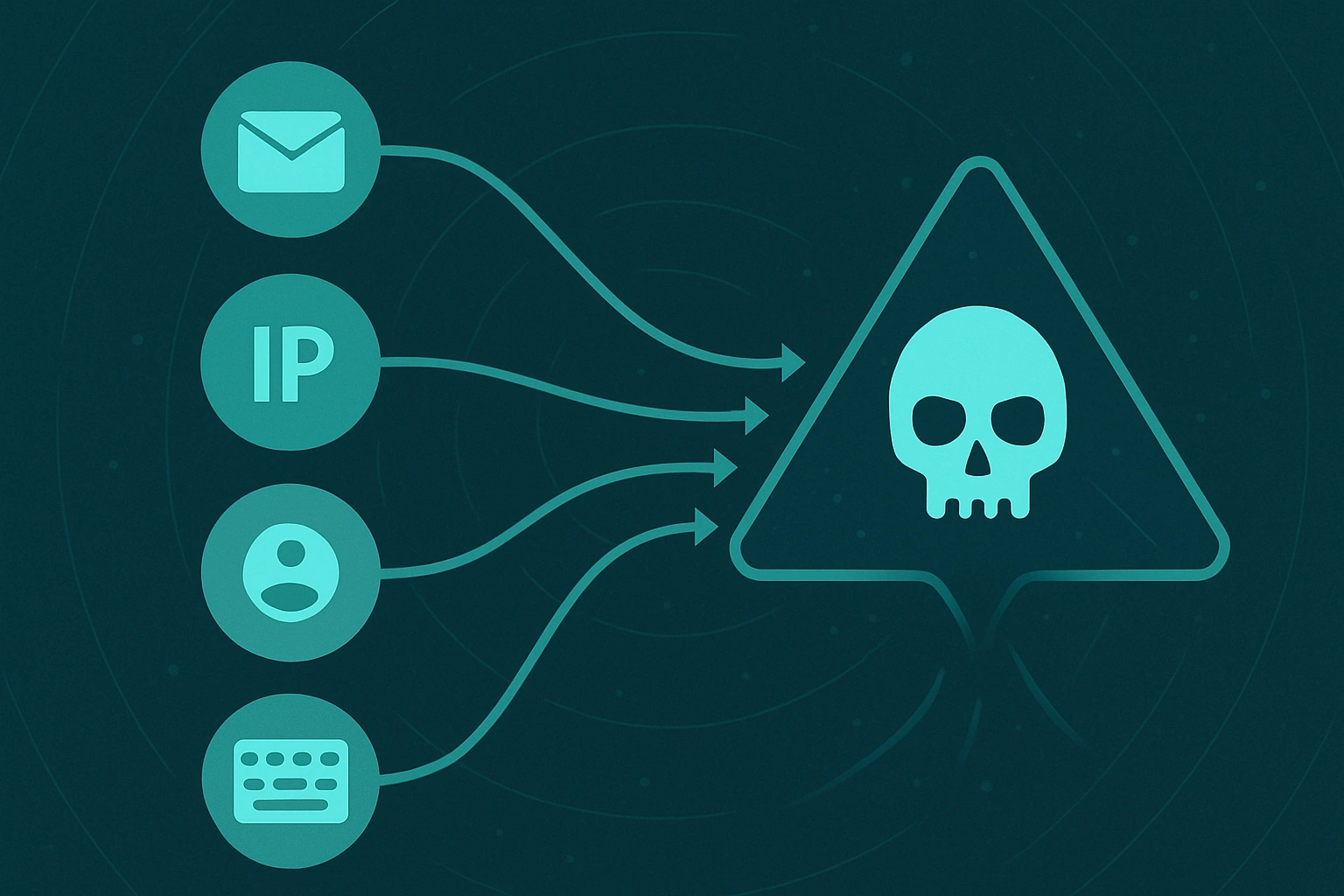
Fraud Protection analyzes every submission across 100+ signals, including behavior, email, IP, device, and input quality. That matters because identity cloning depends on exploiting blind spots between tools.
With multi-signal analysis, your team can:
- Surface clusters of related accounts more quickly
- See reason codes that explain why a submission is high risk
- Route suspicious activity to review before it pollutes downstream systems
- Use one analysis instead of stitching together separate vendors
Fraud Protection does not make decisions for you. It returns advisory risk signals so your team can decide what action to take.
For teams that also want a broader framework, this is exactly the kind of abuse the Identifier Trust Layers approach is designed to expose. The threat is not just a bad email or a bad IP. It is the pattern that emerges when multiple identifiers are cloned together.
How to Reduce Multi-Account Abuse
A practical defense strategy usually includes four parts:
- Collect more than one signal. If you only inspect one field, you are giving attackers a simple target.
- Correlate signals across the submission. Look for combinations, not just anomalies.
- Watch for repeated patterns over time. Identity cloning often becomes obvious in clusters.
- Use advisory scoring with review thresholds. Not every elevated submission should be treated the same way.
If you are still relying on one-off validation, you are probably seeing the most obvious abuse and missing the rest.
Key Takeaways
- Multi-account fraud is effective because it exploits gaps between single checks.
- Identity cloning usually looks normal in one field and suspicious in combination.
- Email validation, IP lookup, and format checks each catch only part of the problem.
- Correlation across email, IP, device, session, and input quality is what exposes abuse clusters.
- Fraud Protection gives your team advisory risk signals, not automated decisions.
- The goal is to surface patterns early enough to review them before they spread.