Best IPQualityScore Alternative for Unified Fraud Prevention
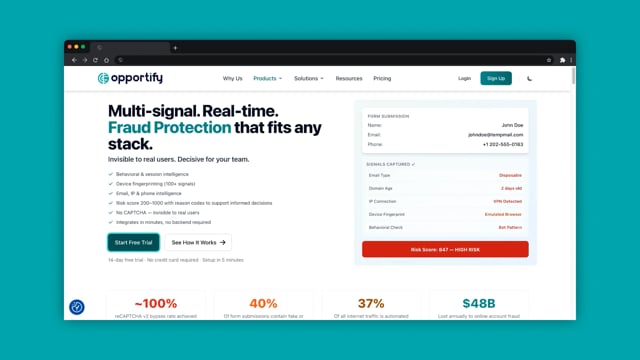
IPQualityScore offers separate APIs for email, IP, phone, and device fraud scoring. We unify all of those signals into a single platform with accessible pricing, modern developer experience, and explainable risk scoring from 200 to 1000.
14-day free trial. No credit card required.

Quick Comparison
How a unified fraud prevention platform compares to fragmented per-API scoring.
| Feature | IPQualityScore | Fraud Protection |
|---|---|---|
Platform Architecture | Separate APIs per product (IP, email, phone, device) | Unified platform: one API call scores all signals |
Risk Scoring | 0–100 fraud score per API | Normalized 200–1000 score with explainable reason codes |
Behavioral Analysis | Not available (data enrichment only) | Typing, mouse, timing, automation detection |
API Security | Sensitive data passed in URL query parameters | Header-based authentication, no data in URLs |
Device Fingerprinting | Enterprise tier only | Included in every analysis |
Integration Speed | Multiple API integrations required | One JS snippet or single API endpoint |
Pricing | Per-API-call, premium features require Enterprise tier | Accessible per-analysis pricing with free trial |
14-day free trial. No credit card required.
What Is IPQualityScore?
IPQualityScore (IPQS) is a fraud detection platform that offers separate APIs for IP proxy detection, email verification, phone validation, and device fingerprinting. It uses a 0 to 100 fraud scoring scale and serves businesses looking to detect proxies, VPNs, disposable emails, and fraudulent transactions.
IPQS operates as a collection of individual services, each requiring separate API calls and configurations. Premium features such as device fingerprinting, residential proxy detection, and advanced blocklists are restricted to higher-priced tiers.
Why Companies Look for an IPQualityScore Alternative
IPQS provides broad coverage but common pain points drive teams to evaluate alternatives.
Expensive pricing that compounds at scale
G2 reviewers consistently cite pricing as IPQS's top complaint. Device fingerprinting, premium blocklists, and residential proxy detection require Enterprise contracts with custom pricing, locking core fraud signals behind higher tiers.
Fragmented APIs require multiple integrations
Each IPQS product (IP, email, phone, device) is a separate API with its own endpoint, documentation, and billing. Scoring a single user across all dimensions requires multiple API calls and data assembly on your side.
Limited explainability in fraud scores
IPQS returns a 0 to 100 fraud score without structured reason codes. Teams cannot easily explain why a submission was flagged or set nuanced thresholds based on specific risk factors.
Sensitive data exposed in API requests
IPQS passes email addresses, phone numbers, and IP addresses as URL query parameters. This means sensitive user data appears in server logs, CDN caches, and browser history rather than being secured in request headers.
14-day free trial. No credit card required.
Use Cases
Where unified multi-signal scoring outperforms fragmented API lookups.
Pre-Onboarding Fraud Detection
Score every signup and registration across behavioral, device, email, and IP signals in a single API call. Detect fake accounts, bot registrations, and synthetic identities before they reach your onboarding pipeline.
Email and IP Risk Intelligence
Validate email deliverability, detect disposable providers, check domain reputation, and assess IP threat level. All signals feed into one normalized risk score instead of requiring separate API calls.
Form Spam and Lead Quality Scoring
Move beyond simple validation. Score every form submission with behavioral analysis, content inspection, and velocity checks to separate legitimate leads from automated abuse and low-quality submissions.
Platform-Agnostic Fraud Scoring
Use the REST API from any backend, SaaS application, or mobile app. SDKs in PHP, Node.js, Java, and Python enable integration in minutes regardless of your tech stack.
14-day free trial. No credit card required.
Who Should Choose Which?
Both platforms serve fraud prevention needs. Choose based on your architecture, budget, and integration requirements.
IPQualityScore is a good fit if…
- •You need on-premise proxy detection databases for high-frequency lookups
- •Your workflow only requires one signal type (e.g., IP-only or email-only checks)
- •You need dark web monitoring or URL/file scanning cybersecurity tools
- •Your enterprise budget can accommodate premium tier pricing for advanced features
Fraud Protection is a good fit if…
- •You want unified scoring across email, IP, device, and behavioral signals in one API call
- •You need accessible pricing without Enterprise contracts for core features like device fingerprinting
- •You want explainable risk scores (200 to 1000) with structured reason codes your team can act on
- •You need behavioral analysis (typing patterns, automation detection) alongside data enrichment
- •Security matters: you prefer header-based API authentication over sensitive data in URLs
- •You want to integrate once and score every form submission, not manage multiple API endpoints
14-day free trial. No credit card required.
Related Resources
Explore multi-signal fraud detection, CAPTCHA bypass research, and form-level scoring.
CAPTCHA Is Dead: Why Bots Win and What Replaces Them
Learn why challenge-based defenses fail against modern bots and what actually detects bad actors.
Read articleSolutionForm Fraud Protection: Detect Fake Leads and Form Abuse
Score every form submission across 100+ signals with one JS snippet. No CAPTCHA needed. Explainable risk scoring for any web form.
Read articleGuideHow to Detect WordPress Form Abuse with Fraud Protection
Detect WordPress form abuse with multi-signal fraud scoring. Use the official plugin to surface risky submissions and act by policy.
Read articleReady for unified fraud prevention?
Replace fragmented API calls with one integration. Explainable risk scoring across email, IP, device, and behavioral signals.
- Access to Email and IP Insights
- Pre-built workflows and SDKs included
Integrate in minutes with one JS snippet or a single API endpoint. SDKs in PHP, Node.js, Java, and Python.
Frequently Asked Questions
How does Fraud Protection compare to IPQualityScore on pricing?
Can I consolidate multiple IPQS APIs into one integration?
Is Fraud Protection faster to integrate than IPQualityScore?
What makes the risk scoring more explainable?
Does Fraud Protection work outside web forms?
POST /intel/v1/fraud/analyze) is a platform-agnostic endpoint. Any application that makes HTTP requests can submit data for scoring: SaaS registration flows, mobile apps, custom backends, or third-party form builders. SDKs are available in PHP, Node.js, Java, and Python.