These are not theoretical vulnerabilities. Commercial bypass services run at scale, 24/7. Bots outperform humans on almost every CAPTCHA type available today.
CAPTCHA Type
Bot Success Rate
Human Success Rate
Primary Bypass Method
Threat Level
Text / Distorted Images
~100%
50–86%
OCR + image preprocessing models
critical
reCAPTCHA v2 ("I'm not a robot")
100%
73–84%
YOLOv8 vision models, confirmed in academic research
critical
Image Grid (pick buses, traffic lights)
85–100%
71–85%
Object detection models trained on common challenge types
Specialized AI solvers + human farms for edge cases
high
Cloudflare Turnstile
40–65%
N/A (no challenge)
Browser automation + behavioral mimicry tools
high
Sources: Tom's Hardware, ScrapingAPI, CHEQ, Capsolver, Multilogin, ThorData, Imperva 2025 Bad Bot Report. Data reflects research published 2024–2026. Bot success rates continue to improve as AI solver models are updated.
The Real Damage
CAPTCHA Does Not Just Fail. It Hurts Your Business.
Even if CAPTCHA stopped bots (it does not), the cost to real users and to your pipeline would still make it a bad trade. Here is what is actually happening on your forms right now.
Conversion Killer
Every friction step reduces form completion. Studies show CAPTCHA challenges cause measurable drop-off at the most critical conversion points. You are paying to acquire visitors and then asking them to solve puzzles before they can become customers.
CAPTCHA is a proven conversion barrier at high-intent touchpoints
Accessibility Failure
Audio and visual challenges create real barriers for users with visual impairments, cognitive disabilities, and motor difficulties. CAPTCHA excludes real people while letting automated bots through. That is the opposite of a security tool.
False Sense of Security
This is the most damaging cost. Teams believe their forms are protected when they are not. While your security posture looks covered on a checklist, bots pass through at near-100% rates and your pipeline fills with fake signups, junk leads, and synthetic identities.
CAPTCHAs bypass rates: 85–100%
Privacy Concerns
Some CAPTCHA providers track user behavior across the web to power their risk models. Your users are profiled across sessions and sites without clear disclosure. Many privacy-conscious users and regulated industries actively avoid services with third-party behavioral tracking embedded in their forms.
Third-party tracking embedded in form flows
The Security Stack
There Is a Gap Between CAPTCHA and KYC
Most businesses jump from basic traffic filtering (CAPTCHA) straight to expensive identity verification (KYC). The two levels in between are where synthetic identities, disposable emails, VPN-masked IPs, and AI-generated submissions pass unchallenged every day.
CAPTCHA / WAF
Traffic Filtering
WAF, rate limiting, IP blocklists, CAPTCHA challenges
Most businesses have this. Bots bypass CAPTCHA at 85–100%.
Fraud Protection
Interaction & Session Intelligence
Most businesses skip this
Behavioral signals, device fingerprinting, session analysis, bot detection without user friction
Almost always skipped. This is where invisible fraud analysis happens.
Fraud Protection
Input & Signal Intelligence
Most businesses skip this
Email validation, IP risk scoring, phone verification, input quality analysis
Often skipped or fragmented across separate tools with no unified score.
Present for high-risk transactions, but expensive and creates heavy friction.
The key insight: Fraud Protection covers the two middle layers: Interaction & Session Intelligence and Input & Signal Intelligence, combined in a single unified platform. These are the levels most businesses skip entirely. This is where fake accounts are created, where junk leads enter pipelines, and where fraud slips through unchallenged.
A Fundamental Shift
From Challenging Users to Reading Signals
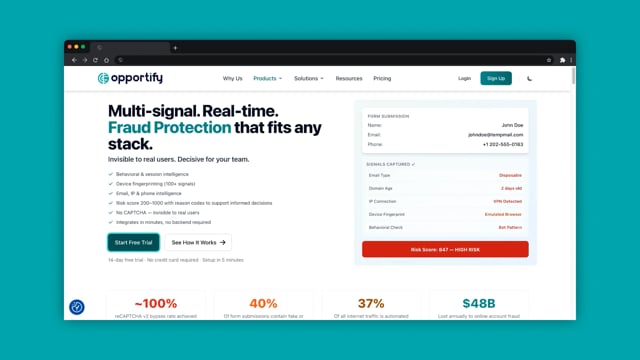
CAPTCHA asks users to prove they are human. Fraud Protection never asks. It analyzes 100+ signals invisibly and gives your team full context on every submission.
The Old Way
Challenge-Based Protection
One gate. Bots learned to pass. Users learned to dread it.
One signal: can the user solve this challenge?
Binary outcome: pass or fail, no context for your team
Friction and drop-off for real users at every form
Bots pass automatically using AI solvers and bypass services
Fake leads and low-quality data reach your pipeline unchecked
The New Way
Signal-Based Protection
100+ signals. Invisible. Unified score your team acts on.
100+ signals analyzed per submission, completely invisible
Behavioral patterns, device fingerprint, email validity, and IP reputation unified
Zero friction for real users, no challenges, no puzzles
Every submission returns a risk score with explainable reason codes
Your team has full risk context on every submission before acting
Every submission is scored across
Behavioral
Typing rhythm, mouse patterns, form interaction timing
Validity, domain reputation, disposable and role-based detection
IP Reputation
VPN, proxy, datacenter, Tor exit node, geolocation risk
Session Context
Navigation flow, time on page, referral path, interaction depth
Risk Score
200–1000
+ Explainable Reason Codes
All outputs are advisory signals. Your team defines the policy and decides the action.
Detect Risk in 4 Simple Steps
Add one snippet. Get explainable risk signals.
1
Add the Snippet
Paste 3 lines of JavaScript onto your form page. No backend changes, no SDK to configure — done in minutes.
<!-- Add inside <head> -->
<script
src="https://cdn.opportify.ai/f/v1.3.4.min.js"
data-opportify-key="YOUR_PUBLIC_KEY"
>
</script>
2
Protect Your Forms
Create a Form Endpoint in the dashboard and point your form to the secure submit URL. The snippet handles everything else automatically.
EmailIPDeviceBehaviorPhone
3
Review by Risk Level
Every submission arrives pre-scored and classified. Your dashboard shows all submissions segmented by risk — no manual triage needed.
LOWESTLOWMEDIUMHIGHHIGHEST
4
Act on the Score
Route clean, low-risk submissions to HubSpot, Salesforce, Slack, or any webhook receiver. Review, flag, or reject high-risk and suspicious submissions before they reach your CRM — your team stays in control.
WebhookHubSpotZapierSlackEmail alert
Connects to Everything You Already Use
Fraud Protection delivers results via webhooks and native integrations. Route verified leads directly to your CRM and high-risk events to your alerting stack. Pick from 34 pre-configured destinations or connect any webhook-capable tool. The official WordPress plugin is also available for direct deployment. Via Zapier or Make, you unlock thousands more apps with zero code.
ZapierMaken8nAirtableNotionHubSpotSalesforcePipedriveZoho CRMClose CRMGoHighLevelApollo.ioMonday.comSlackMicrosoft TeamsDiscordPagerDutyOpsGenieSplunkDatadogNew RelicActiveCampaignMailchimpKlaviyoBrevoCustomer.ioLemlistZendeskIntercomFreshdeskSegmentClayRelevance AIVapi+ any custom webhook
Install the official WordPress plugin to score submissions across 100+ signals. Configure allow, flag, or block actions by risk level for comments, registrations, checkouts, and form plugins.
Supports Contact Form 7, WPForms, Gravity Forms, Elementor Pro, Ninja Forms, Fluent Forms, Forminator, Formidable Forms, WooCommerce, and more.
Academic and security research published in 2024–2026 confirmed that AI vision models such as YOLOv8 achieve a 100% success rate against reCAPTCHA v2. Standard image CAPTCHAs are bypassed at 85–100% success rates by automated solvers. Audio CAPTCHAs are bypassed by speech-to-text APIs at 85–95% success rates, significantly higher than the 46–67% human success rate. More advanced CAPTCHAs such as Cloudflare Turnstile are harder to bypass but still fall between 40–65% bot success rates.
Should I remove CAPTCHA from my forms?
Yes. Fraud Protection analyzes every submission across 100+ signals: behavior, device, email, IP, and session context, with no challenges, no puzzles, and no friction for real users. Most teams remove CAPTCHA entirely after a short transition period where they run both in parallel to validate risk scores. Fraud Protection is designed to work standalone from day one.
How does Fraud Protection analyze submissions without friction?
A lightweight JavaScript snippet loads on your form page and silently collects device fingerprints, behavioral patterns, and session signals as the user interacts with your form. No challenges, no puzzles, no UI elements. When the form is submitted, the snippet proxies the submission through a secure endpoint where it is scored across 100+ signals: behavioral, device, email, IP, and session. A risk score from 200 to 1000 is returned with explainable reason codes.
What does the risk score tell me?
Every submission returns a normalized risk score between 200 and 1000 along with structured reason codes explaining which signals contributed to the score. Score levels are: lowest (200–300), low (301–400), medium (401–600), high (601–800), and highest (above 800). The outputs are advisory signals. Your team defines the policy and decides what action to take. You remain in full control of all decisions.
Does this replace my KYC or identity verification provider?
No. Fraud Protection operates in the pre-onboarding layer between traffic filtering and identity verification. It analyzes submissions before they reach KYC, filtering out obvious fake accounts, bots, and synthetic identities so your KYC process only sees higher-quality submissions. This reduces KYC costs and friction for real users. It is a complementary layer, not a replacement.
What happens to my existing forms? Do I need to rewrite anything?
Integration requires two small frontend changes: add one JavaScript snippet to the pages containing your forms, and update each form's action to point to your Fraud Protection endpoint. No backend changes are required. Your existing backend continues to receive submissions as normal, now pre-scored and enriched. Your forms continue to look and feel exactly the same to your users. Integration takes minutes, not days.
Can sophisticated bots bypass Fraud Protection?
No security tool provides absolute protection, and Fraud Protection does not claim to. Unlike CAPTCHA, which relies on a single challenge that bots solve once and reuse infinitely, Fraud Protection analyzes behavioral patterns, device context, session signals, email risk, and IP reputation together. Defeating multi-signal behavioral analysis requires significantly more effort and cost than bypassing a puzzle. The outputs are risk signals your team acts on; policy decisions remain yours.
What is the pricing?
We offer flexible plans for every scale, starting at 1,000 analyses per month, with a 14-day free trial and no credit card required. View all plans and pricing.