Clean Data Starts at Ingestion: A Data Engineer's Guide to Email Intelligence
Email data gets expensive when you clean it too late. By the time a bad record reaches your warehouse, it has already polluted dashboards, triggered unnecessary downstream jobs, and forced your team to fix problems in batch. The better move is to validate email intelligence at ingestion, where the signal is freshest and the cleanup cost is lowest.
For data engineers, that means treating email intelligence as a pipeline control, not just a marketing hygiene check. The goal is simple: catch low-quality, disposable, malformed, or high-risk addresses before they become permanent parts of your system.
Why Email Validation at Ingestion Matters
Every ingestion pipeline has a quality boundary. If you do not enforce it early, bad records spread quickly through your stack.
A single poor-quality email can affect multiple systems:
- analytics events and warehouse tables
- CRM sync jobs
- lifecycle automation
- attribution and reporting
- downstream enrichment workflows
When the data lands clean, every layer below it gets easier to trust. That is especially true for identifiers, where a record can look valid at the schema level and still be operationally risky.
The most common mistake is assuming format validation is enough. A string can match an email regex and still be disposable, undeliverable, or tied to a low-quality source. At ingestion, you need more than syntax. You need signal.
What Email Intelligence Adds Beyond Format Checks
Format checks only answer one question: does this look like an email address?
Email intelligence asks a better question: what does this address tell you about the quality of the record entering your system?
With Email Insights, teams can analyze an address across multiple dimensions, including:
- mailbox reachability
- domain reputation
- provider type
- disposable or temporary status
- authentication posture
- domain age and stability
- risk score and reason codes
That context helps you decide whether a record should enter your primary pipeline, a quarantine queue, or a follow-up verification flow.
The 8 Email Dimensions That Matter in a Pipeline
At ingestion time, the most useful email signals are the ones that help you separate trustworthy records from records that will create cleanup work later.
1. Deliverability
Can mail reach this address? If not, the record is already weak for most downstream use cases.
2. Provider Type
Free, disposable, role-based, and private or organizational domains often behave differently. That difference matters when you are scoring ingestion quality.
3. Domain Reputation
A domain with poor reputation is a risk signal even when the address format looks clean.
4. Authentication Signals
SPF, DKIM, and DMARC posture help you understand whether the domain has baseline mail authentication hygiene.
5. Domain Age
Very new domains often deserve extra scrutiny, especially when they appear in high-volume sign-up streams.
6. Disposable Status
Temporary email services are useful for throwaway activity, but they are rarely a good sign for long-term data quality.
7. Risk Score
A normalized score gives your pipeline a consistent way to sort records by risk instead of relying on one-off rules.
8. Reason Codes
Reason codes help you understand why a record was flagged, which makes pipeline policy easier to defend and adjust.
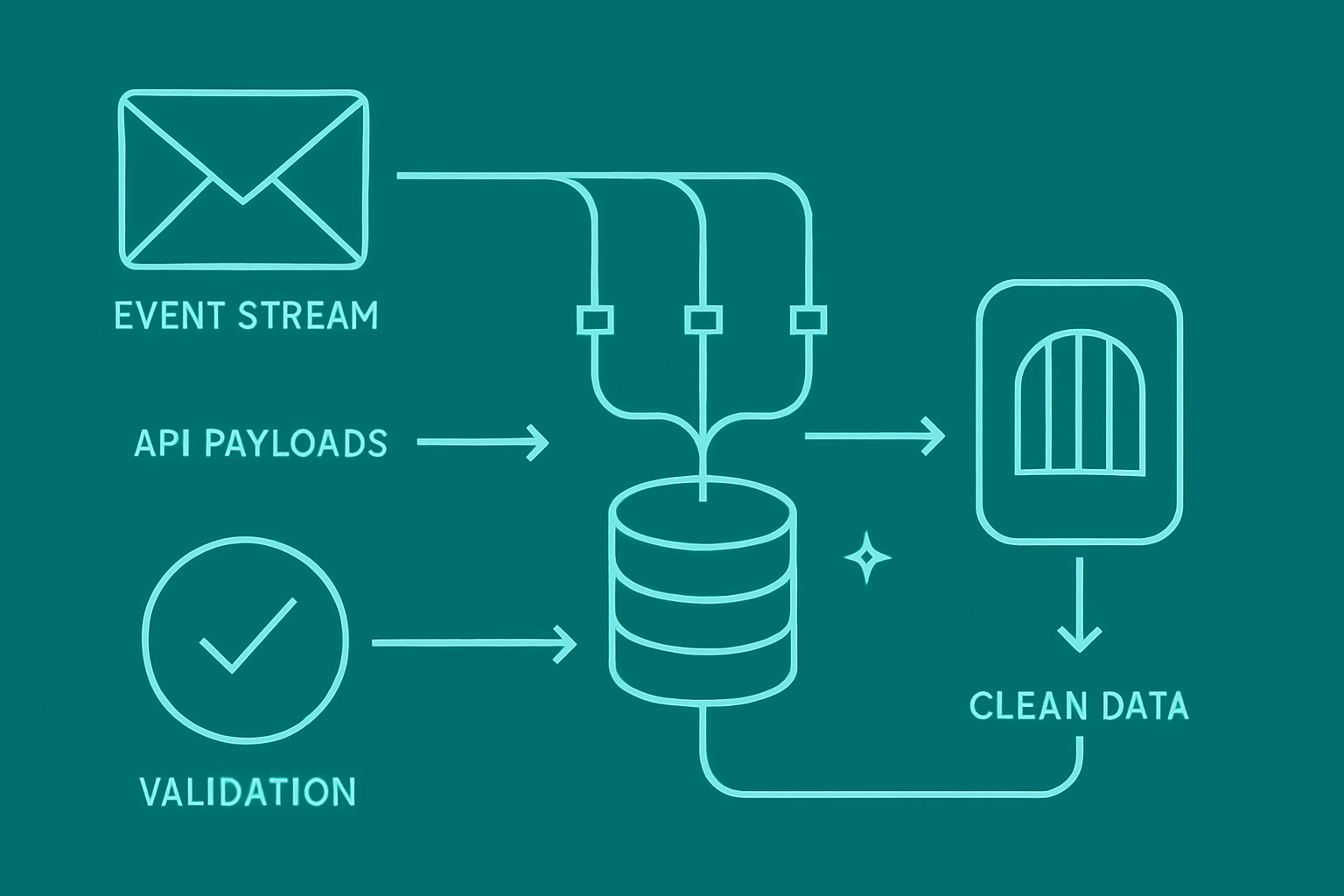
Ingestion vs. Batch Validation Patterns
There are two common ways teams handle email data quality.
Ingestion-time validation
This is the strongest pattern when you want clean systems.
The submission is checked as it arrives, and the result can immediately determine how the record is routed. Common outcomes include:
- accept into the primary table
- quarantine for review
- mark as low quality
- enrich asynchronously
- suppress from activation workflows
This pattern works well when you want to keep your warehouse, CRM, and downstream jobs clean from the start.
Batch validation
Batch validation still has a place, especially for legacy datasets or imported lists. It is useful when you are cleaning historical records or reprocessing older exports.
The tradeoff is obvious: the bad data has already landed. That means more cleanup, more joins, and more rework.
For most modern teams, ingestion-time validation should be the default and batch cleanup should be the fallback.
A Practical Python Example
Below is a simple pattern for validating email records at ingestion. The exact implementation will depend on your stack, but the workflow stays the same.
import requests

API_URL = "https://api.opportify.ai/insights/v1/email/analyze"
API_KEY = "YOUR_API_KEY"


def analyze_email(email):
    payload = {"email": email}
    headers = {
        "x-opportify-token": API_KEY,
        "Content-Type": "application/json",
    }

    response = requests.post(API_URL, json=payload, headers=headers, timeout=10)
    response.raise_for_status()
    return response.json()


def route_record(record):
    result = analyze_email(record["email"])

    if result["riskReport"]["score"] >= 800:
        return "quarantine"
    if result["emailType"] == "disposable":
        return "review"
    return "accept"
This kind of logic lets your pipeline make routing decisions based on risk signals rather than simple pass or fail checks.
Warehouse Orchestration Tips
If you are implementing email intelligence in a warehouse-first architecture, keep the following patterns in mind:
- store raw submission payloads separately from enriched outputs
- preserve the original email alongside the analysis result
- use a normalized risk score for routing and reporting
- keep reason codes available for auditability
- apply the same policy across ingestion sources so your rules stay consistent
The most common failure mode is inconsistent enforcement. If one source validates at ingestion and another waits until batch processing, your data model becomes hard to trust.
How Email Insights Fits Into the Workflow
Email Insights is built for teams that need signal at the moment a record enters the system. It can be used to validate individual records, score bulk uploads, or power automated routing rules in a pipeline.
For data engineers, the value is not just the score itself. It is the ability to standardize email quality checks across every source, from forms and API events to imported lists and enrichment jobs.
That makes cleaner data easier to maintain and easier to operationalize across the rest of your stack.
Key Takeaways
- Format checks are not enough. A valid string is not the same thing as a trustworthy record.
- Email intelligence helps you route records at ingestion before bad data spreads through your system.
- The most useful dimensions are deliverability, provider type, reputation, authentication, age, disposable status, risk score, and reason codes.
- Ingestion-time validation is better than batch cleanup when you want to keep warehouses and CRMs clean.
- A normalized score and reason codes make policy easier to apply and easier to explain.
- Clean data at the boundary is cheaper than cleanup after the fact.