
Conversion Impact
Every friction step reduces form completion. CAPTCHA challenges cause measurable drop-off at high-intent touchpoints. You invest in acquiring traffic, then ask visitors to solve a puzzle before they can convert.
No CAPTCHA. 100+ Signals. No Friction for Real Users.
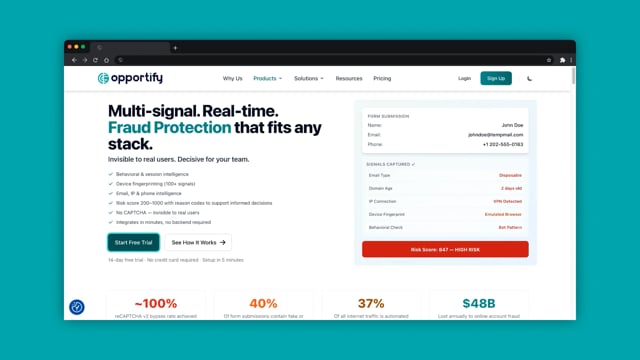
CAPTCHA relies on a single challenge and creates friction for real users, while facing increasing accuracy limitations against automation. Opportify analyzes every form submission across 100+ behavioral, device, email, and IP signals, completely invisible to your users, with explainable risk scores your team can act on.
14-day free trial. No credit card required.
Independent security research published between 2024 and 2026 consistently shows that CAPTCHA faces increasing accuracy gaps as automation technology advances. Bots match or exceed human performance on most widely deployed CAPTCHA types today.
| Challenge Type | Bot Detection Rate | Human Completion Rate | Coverage Gap | Research Finding |
|---|---|---|---|---|
| Text / Distorted Images | Low | 50–86% | Automated solvers match or exceed human accuracy | significant |
| reCAPTCHA v2 ("I'm not a robot") | Low | 73–84% | Vision models achieve high accuracy on this challenge type | significant |
| Image Grid (buses, traffic lights) | Low | 71–85% | Object detection models trained on common challenge types | significant |
| Audio Challenges | Low | 46–67% | Speech-to-text APIs outperform humans on audio challenges | significant |
| hCaptcha | Moderate | 75–90% | Specialized solvers continue to improve monthly | notable |
Sources: Tom's Hardware, CHEQ, Imperva 2025 Bad Bot Report. Data reflects research published 2024–2026. Detection gap figures are based on published third-party accuracy studies.
CAPTCHA's limitations go beyond detection accuracy. Puzzles hurt conversions, exclude users with disabilities, provide no actionable context when submissions get through, and embed third-party tracking in your forms. Here is what is actually at stake across your submissions today.
Every friction step reduces form completion. CAPTCHA challenges cause measurable drop-off at high-intent touchpoints. You invest in acquiring traffic, then ask visitors to solve a puzzle before they can convert.
Audio and visual CAPTCHA challenges create real barriers for users with visual impairments, cognitive disabilities, and motor difficulties. CAPTCHA can exclude real users while missing automated submissions. That is the opposite of effective protection.
CAPTCHA provides a pass or fail with no context. When a submission gets through, your team has no insight into its quality, origin, or risk level. Low-quality submissions, fake signups, and synthetic identities enter your pipeline with no signal to act on.
Some challenge providers track user behavior across the web to power their risk models. Your users are profiled across sessions and sites without transparent disclosure. Many privacy-conscious users and regulated industries actively avoid services with third-party behavioral tracking embedded in their forms.
Most businesses jump from CAPTCHA straight to expensive identity verification. The two layers in between are where synthetic identities, disposable emails, VPN-masked IPs, and automated submissions enter pipelines unchallenged every day.
WAF, rate limiting, IP blocklists, single-challenge verification
Most businesses have this layer. CAPTCHA's accuracy limitations mean more coverage is needed.
Behavioral signals, device fingerprinting, session analysis, and risk scoring without user friction
Most businesses skip this layer. This is where invisible, multi-signal fraud analysis operates.
Email validation, IP risk scoring, phone verification, and input quality analysis
Often skipped or fragmented across separate tools with no unified risk score.
Document checks, biometrics, liveness detection, KYC/AML compliance
Present for high-risk transactions, but expensive and introduces heavy user friction.
The key insight: Opportify covers the two middle layers: Interaction and Session Intelligence and Input and Signal Intelligence, in a single unified platform. These are the layers most businesses skip entirely. This is where low-quality leads enter pipelines and where fraud slips through without a signal.
Detect fake leads, low-quality submissions, form spam, and bad bots by analyzing every form submission across 100+ signals — behavior, email, IP, device, and more. No CAPTCHA puzzles. No friction for real users. No single challenge point that automation can get around.
Paste a single script tag onto any page with a form. No backend changes, no infrastructure setup, no SDK to configure. The snippet loads silently in the background.
As the user fills out your form, Fraud Protection analyzes device fingerprints, behavioral timing, form interaction patterns, and network signals, all without challenging the user or showing any UI.
Each submission returns a risk score from 200 to 1000 with explainable reason codes. Your team reviews, routes, or flags based on your policy. The outputs are advisory signals. You decide the action.
Route scored submissions to HubSpot, Salesforce, Slack, or any webhook receiver. Review high-risk submissions before they enter your pipeline. Your team sets the threshold. The score gives you the signal.
A 1-minute overview of how Fraud Protection scores form submissions across multiple signals before they reach your pipeline.
| Capability | CAPTCHA | Opportify Fraud Protection |
|---|---|---|
| Submission analysis depth | One signal: can the user solve this challenge? | 100+ signals: device, behavioral, email, IP, session, network |
| User friction | High: puzzles, delays, and repeated failures for real users | None: completely invisible to real users |
| Conversion impact | Negative: measurable drop-off at form submission | Neutral: zero change to user experience |
| Accessibility | Limited: excludes users with visual or cognitive disabilities | Full: no user interaction required at any point |
| Explainability | None: pass or fail with no context provided | Reason codes per submission, review and tune thresholds |
| Team control | Binary outcome, no policy configuration | Risk score (200–1000), your team defines the action |
| Data privacy | Third-party behavioral tracking embedded in your form flows | First-party analysis: your data stays in your pipeline |
Accessible pricing for businesses of any size
14-day free trial. No credit card required.
All signals bundled: behavioral, device, email, IP, and session intelligence in every analysis.
Opportify is purpose-built to help businesses improve form data quality and reduce fraudulent submissions. The platform operates on clear principles of transparency, advisory output, and customer control.
Opportify Fraud Protection is designed to detect and reduce fraudulent or low-quality form submissions. It is not intended to bypass, evade, or interfere with existing security systems. All analysis operates on form submission data your business has a legitimate interest in protecting.
All outputs from Fraud Protection are advisory risk signals. The platform scores each submission and provides explainable reason codes. Your team remains in full control of all decisions. Opportify does not automatically block, restrict, or take action on any submission.
Risk score thresholds, routing rules, and follow-up actions are entirely configured by your team. You define what constitutes a high-risk submission for your business and what action to take. The platform provides intelligence. Policy and decisions remain yours.
Opportify Fraud Protection is designed to help businesses detect and reduce fraudulent or low-quality form submissions. It is not intended to bypass, evade, or interfere with existing security systems. All outputs are advisory signals. Your team remains in control of all decisions.
100+ signals per form submission. No puzzles for real users. Explainable risk scores and reason codes your team can act on. Deploy in minutes.
14-day free trial. Accessible pricing from $9/month.