Bot and Fraud Trends 2026: What the Data Says About Bots, Fake Sign-Ups and Form Abuse
As 2026 winds down, the research published this year tells a consistent story for anyone who runs a sign-up, lead, or trial form: automated traffic is now the norm, the bots in it act more like people, and the fake identities behind abuse are better built. This post collects the figures we could verify on each publisher's own page, states what each one measures, and explains what it means in practice for teams that protect forms.
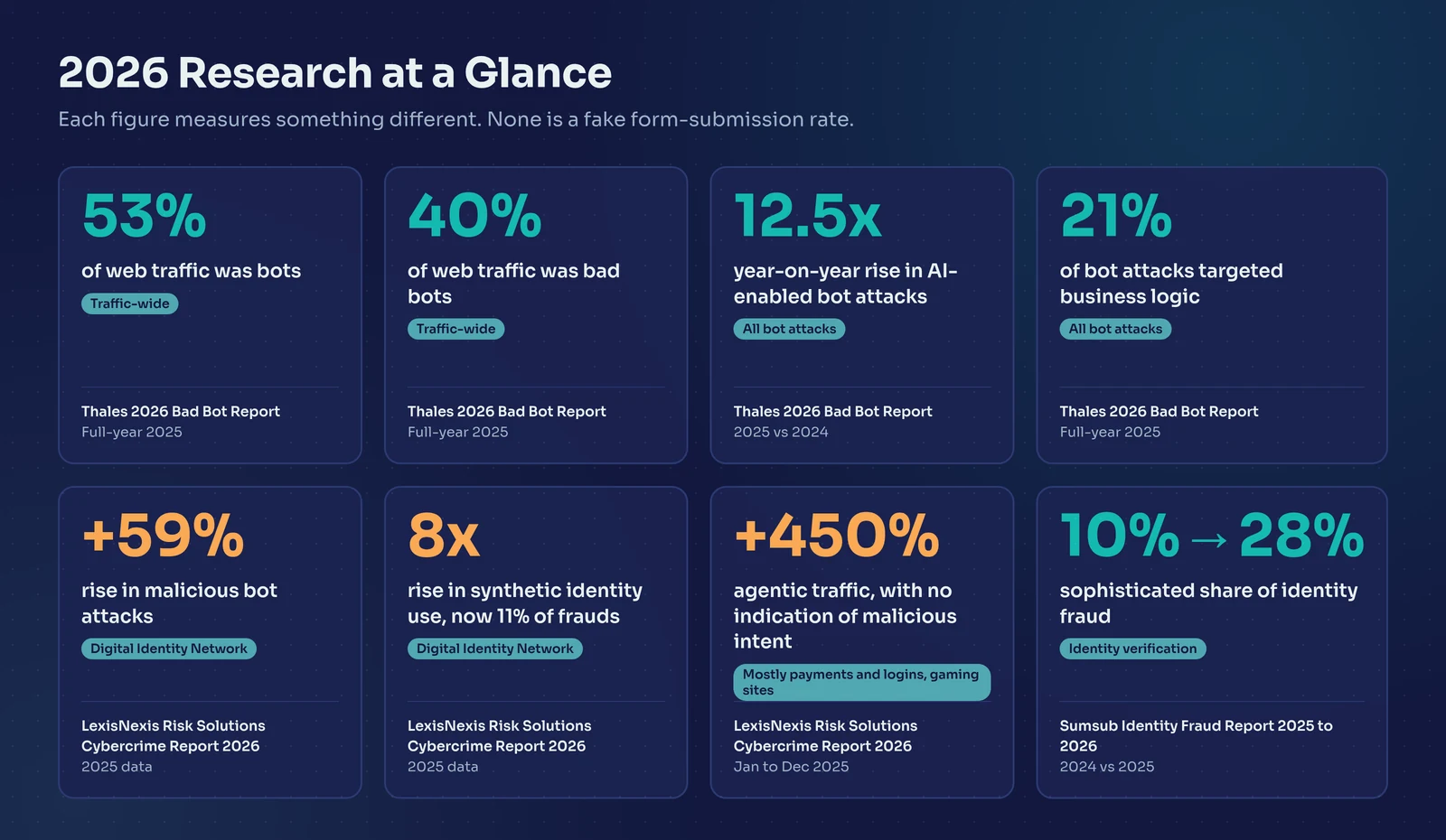
A note on reading these numbers. Most reports published in 2026 describe activity in 2025, and each measures something different: share of web traffic, fraud seen in identity checks, or abuse on a payments network. None of them is a rate of fake form submissions, and we do not present them as one.
Bots Are Now the Majority of Web Traffic
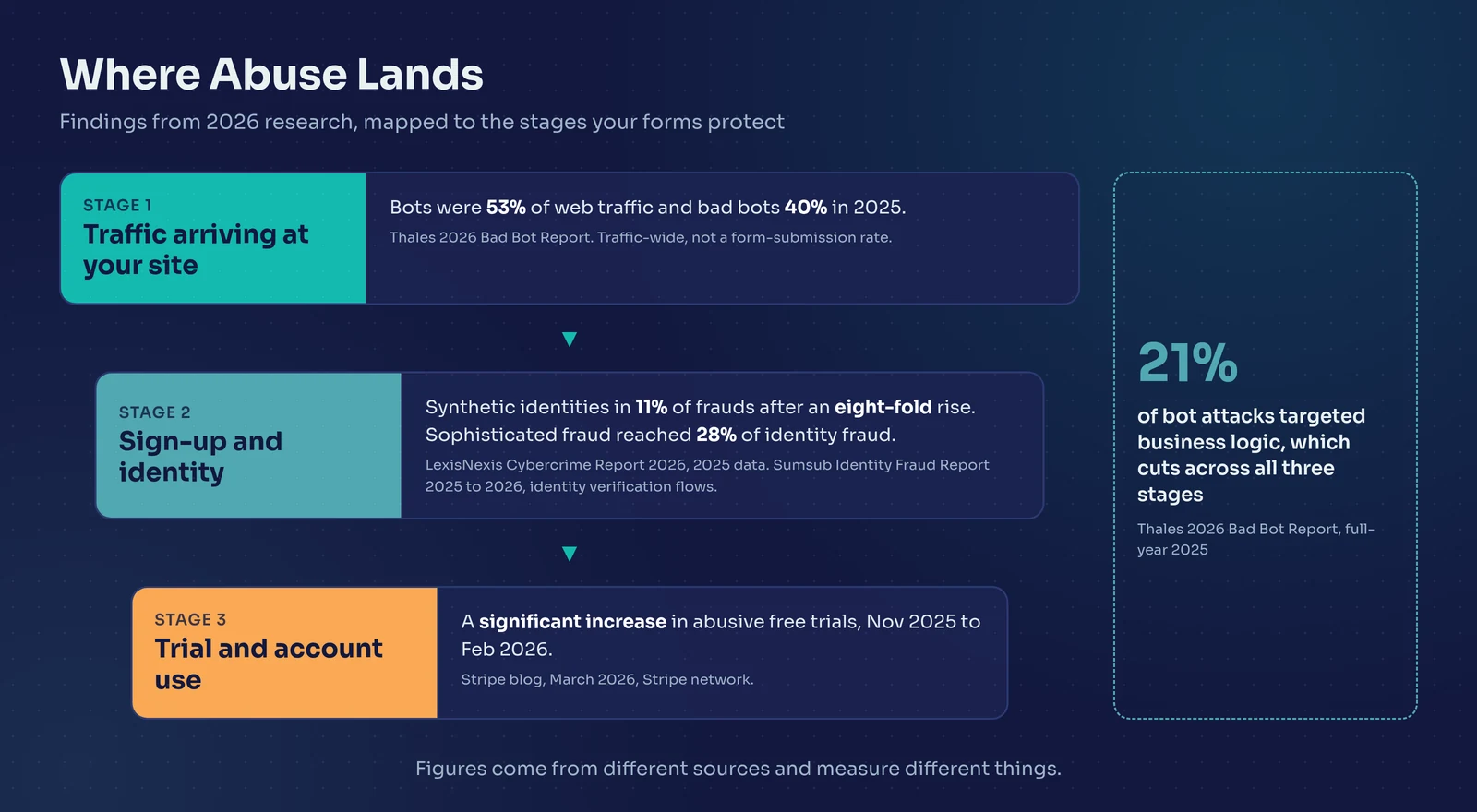
The Thales 2026 Bad Bot Report, based on full-year 2025 bot activity, puts bots at 53% of web traffic and bad bots at 40% of web traffic. Human traffic was 47%.
These are traffic-wide figures from the traffic Thales analyzed. They do not say that 40% of your form submissions are fake. What they do say is that the traffic arriving at your forms comes from a web where automated requests outnumber human ones, so "a person filled this in" is an assumption to check, not a default.
Bots Go After the Logic, Not Just the Page
The same Thales report finds that 21% of bot attacks targeted business logic in 2025, and that AI-enabled bot attacks rose 12.5x year on year. Business logic is the part of an application that encodes your rules: who can create an account, how many trials one person gets, what a referral pays out. Sign-up and trial flows are business logic.
In practice, this means a form can be abused while every request looks valid. The fields are well formed, the email domain exists, and the submission passes basic validation. The abuse is in the pattern: how many, how fast, from where, and how they relate to each other.
Bots Increasingly Act Like People
The LexisNexis Risk Solutions Cybercrime Report 2026, which analyzed more than 116 billion transactions on its Digital Identity Network between January and December 2025, reports a 59% rise in malicious bot attacks. The report says bots "can now mimic genuine human actions, such as how we move a cursor around a login screen, with a high degree of plausibility to fool the latest behavioral fraud detection tools."
The practical point is that any single behavioral check can be imitated. A signal that was strong evidence a few years ago is weaker on its own today. It still has value when it is read together with other signals that are harder to fake at the same time.
Not Every Automated Visitor Is Hostile
The same LexisNexis report records a 450% rise in agentic traffic between January and December 2025, mainly linked to credit card payments and logins at gaming and gambling sites. The report is careful to say there was "no indication of malicious intent." It describes these agents as "a third type of digital interaction in addition to genuine human transactions and traditional bots."
This matters for forms. "Automated" and "fraudulent" are no longer the same thing, so a rule that rejects anything non-human will start to turn away legitimate use. A score with reasons, sent to a step your team defines, holds up better than a yes or no.
Fake Identities Got Better, Not Just More Common
Two reports point the same way. LexisNexis found that more than one in ten frauds (11%) on its network now involve a synthetic identity, an eight-fold increase year over year, which makes it the fastest-growing fraud type in the report. The report explains that fraudsters stitch these identities together from various stolen identity attributes, and that they can take months to establish.
The Sumsub Identity Fraud Report 2025 to 2026, published in November 2025 and based on identity verification data, found that the share of sophisticated, multi-step attacks rose from 10% of identity fraud in 2024 to 28% in 2025. Over the same period the overall identity fraud rate fell from 2.6% to 2.2%. Sumsub calls this the Sophistication Shift: "fewer but more professionalized operations designed for higher-impact damage."
Both figures come from identity and verification flows rather than from web forms. The lesson carries over: a better-built fake identity passes more single checks. An email address can be real, deliverable, and still part of a coordinated pattern.
Trial and Sign-Up Abuse Kept Rising
In a March 2026 analysis, Stripe reported "a significant increase in abusive free trials across Stripe's network" from November 2025 to February 2026. It describes the wider shift as first-party fraud: real users who set up multiple accounts, cycle through free trials, or exploit refunds.
For SaaS teams, this is the most familiar pattern on the list. The person is real, the card may be real, and the abuse is in the repetition. Our guide to free trial abuse in SaaS and our post on multi-account fraud cover the patterns in detail.
What This Means for Your Forms in 2027
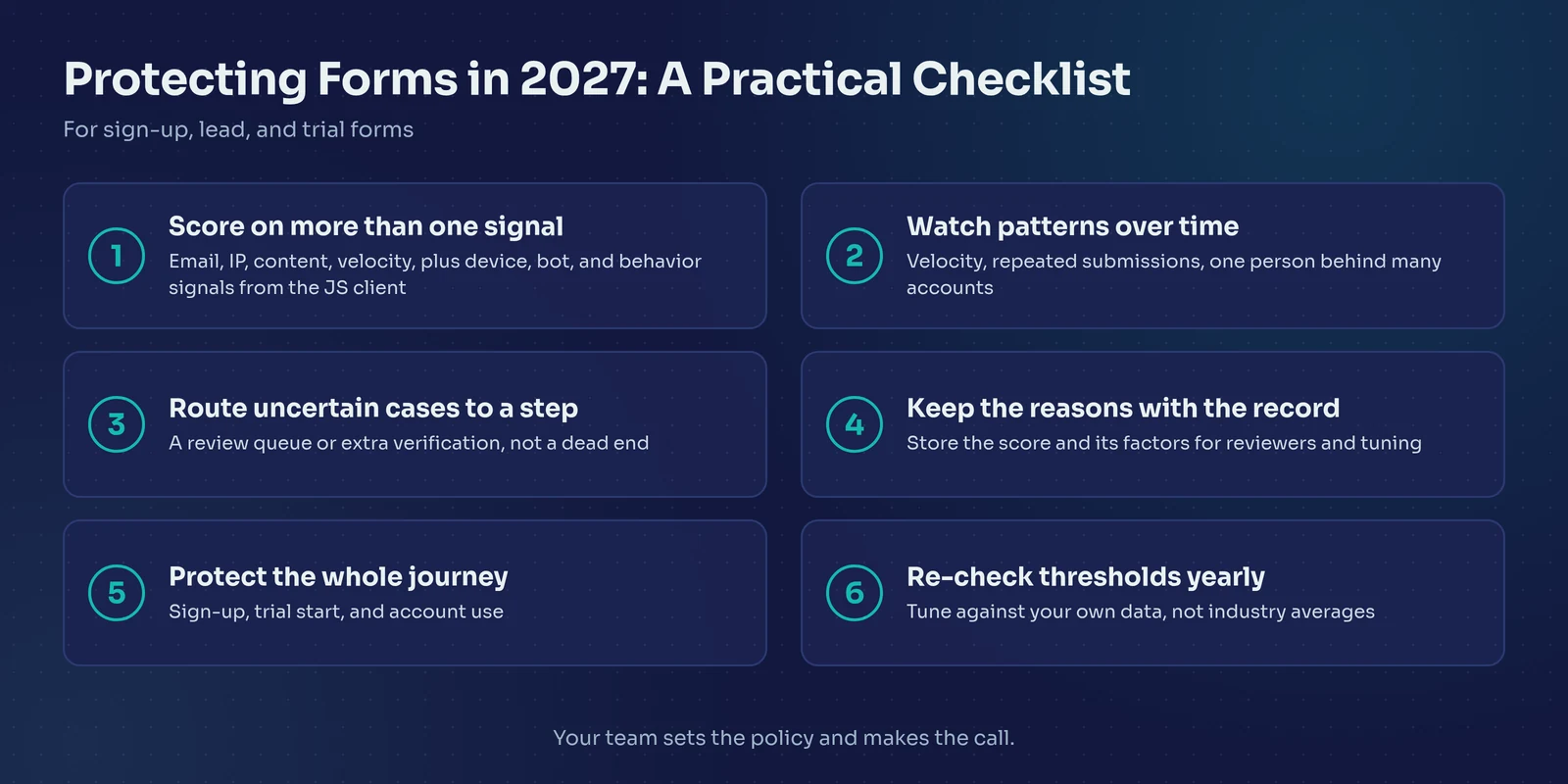
None of these reports measures your traffic, and none of them should set your thresholds. Read together, they support a few practical steps:
- Score every submission on more than one signal. Email, IP, content, and velocity signals each show part of the picture, and the JS client adds device, bot, and behavior signals. A coordinated pattern often shows up only when you read them together. Our multi-signal stack guide covers the architecture.
- Look at patterns over time, not just single requests. Business-logic abuse and trial cycling show up in velocity and repetition: many similar submissions in a short period, or one person behind several accounts.
- Send uncertain cases to a step, not a wall. With legitimate agents and privacy tools in the mix, a review queue or an extra verification step costs less than turning away a real customer.
- Keep the reasons with the record. A score with plain-language factors lets reviewers make a call and lets you tune your policy later.
- Protect the whole journey. Abuse lands at sign-up, at trial start, and after. The Identifier Trust Layers framework maps where trust breaks down across that lifecycle.
- Re-check your assumptions each year. The numbers above will move. Tune your policy against your own data.
How We Fit In
We score and flag; your team decides what to act on. Fraud Protection analyzes each form submission across multiple signals and returns a risk score with the reasons behind it. It runs three ways: Form Fraud Protection (the JS client on its own), the Fraud Protection API, or Full Signal, the Fraud Protection API and the JS client together, so one risk score uses both enrichment and behavioral signals. The JS client is what adds device, bot, and behavior signals. For network context on its own, IP Insights returns connection type, blocklist evidence, and an Explainable Risk Report for any address, and you can try it in the free IP reputation checker. See pricing for plans.