Layer 3: Identity Verification Catches False Claims. It Cannot Undo What Slipped Through Earlier.
This is Post 4 in the Identifier Trust Layers series by Opportify, a framework that maps where trust can be evaluated across the full user lifecycle, and where the gaps are. Each post covers one layer in depth.
The Identifier Trust Layers are Opportify's original framework. It is not an industry standard or third-party model.
Identity verification often feels like the moment trust is finally established. Documents are checked. A face is matched. A watchlist is queried. That work matters. It also arrives after a submission has already entered your process.
If a low-quality or fabricated submission reached this stage, the review and the verification handling have already started. Layer 3 can catch a false identity claim. It cannot undo what slipped through earlier.
A Short Recap of Identifier Trust Layers
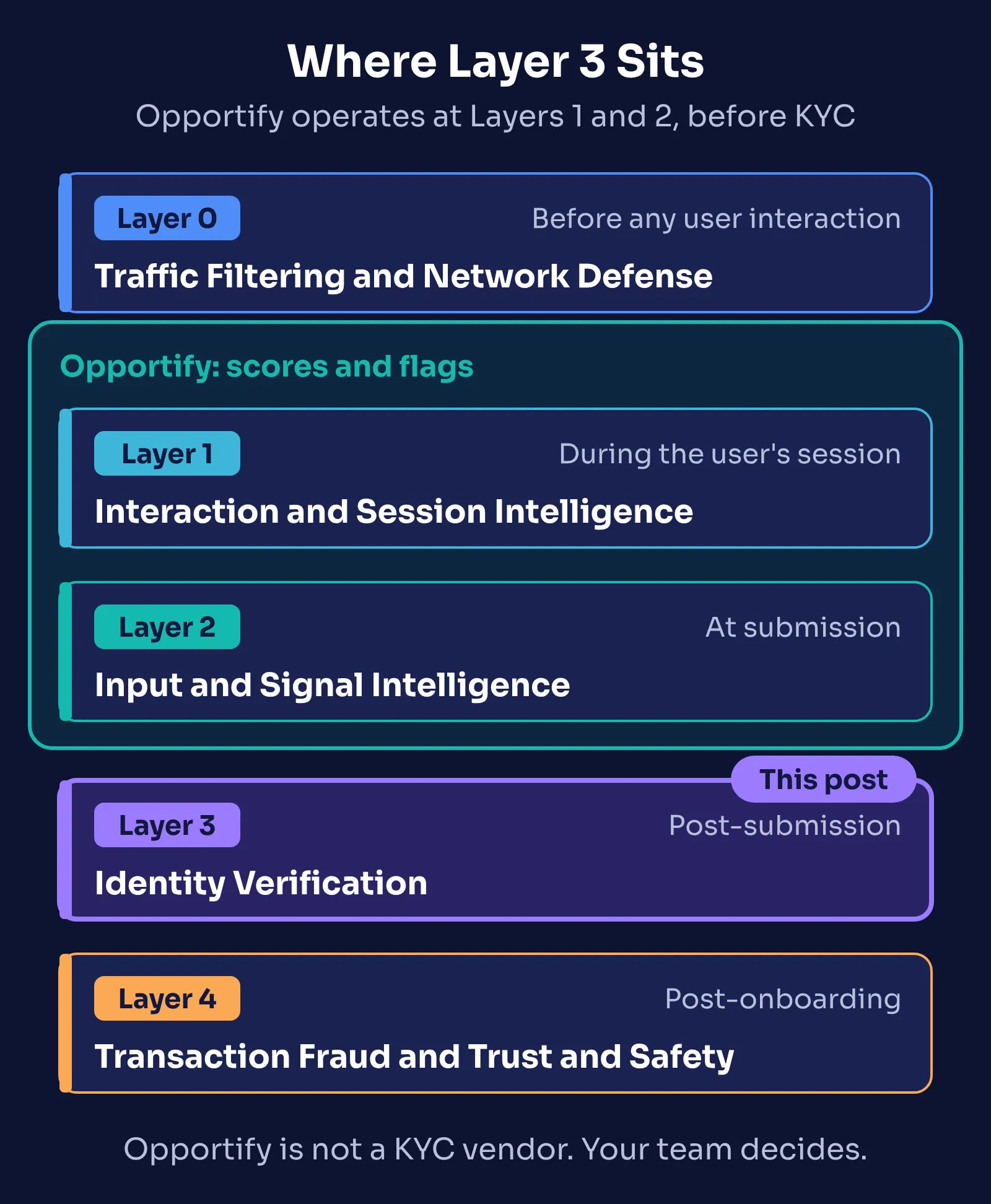
Opportify's Identifier Trust Layers framework maps where trust is evaluated across the user lifecycle. The full introduction lives in Why Trust Cannot Be Built in a Single Layer. Here is the five-layer map, using the same descriptive names as that overview:
| Layer | Name | When | What it evaluates |
|---|---|---|---|
| Layer 0 | Traffic Filtering and Network Defense | Before any user interaction | WAF rules, rate limiting, IP blocklisting, CDN-level threat filtering |
| Layer 1 | Interaction and Session Intelligence | During the user's session | Behavioral signals, device fingerprinting, session analysis, CAPTCHA |
| Layer 2 | Input and Signal Intelligence | At submission | Email, phone, IP, and input signal analysis |
| Layer 3 | Identity Verification | Post-submission | Document checks, liveness detection, face match, AML/PEP/sanctions screening |
| Layer 4 | Transaction Fraud and Trust and Safety | Post-onboarding | Payment fraud, account takeover, chargeback abuse, marketplace manipulation |
Each layer has a job and a blind spot. This post focuses on Layer 3: Identity Verification.
What Layer 3 Typically Includes
After submission, when a business decides to verify a user, identity verification tools become relevant. In the Identifier Trust Layers overview, the tools that operate at this layer are document checks, liveness detection, face match, and AML/PEP/sanctions screening.
That list is educational and vendor-neutral. It describes the kinds of checks teams run when they need to confirm an identity claim. It is not a product catalog for Opportify. Opportify does not offer a KYC, eKYC, or AML product, and it does not operate at Layer 3.
What Layer 3 Is Designed to Catch
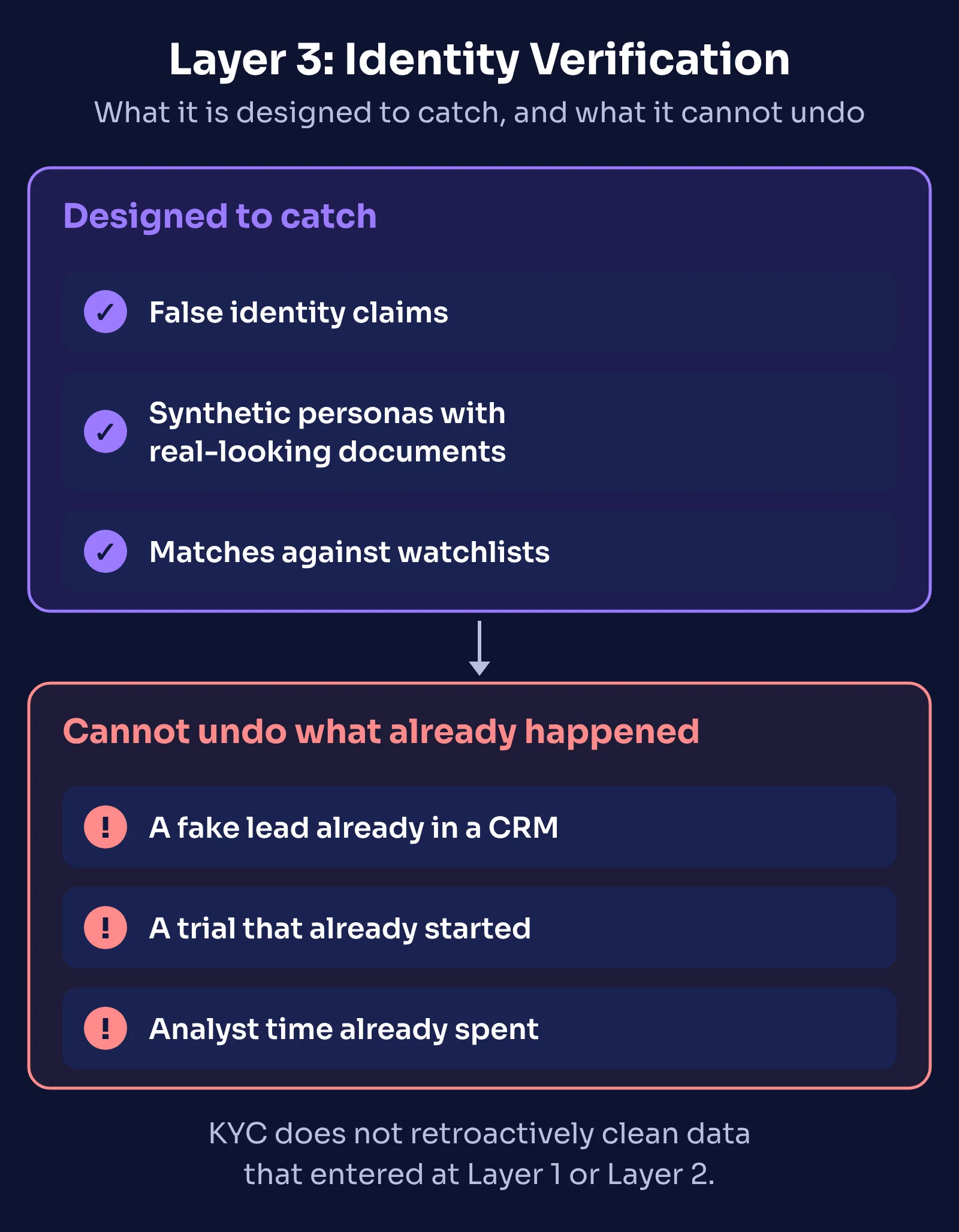
The overview states the purpose of this layer clearly. Layer 3 is designed to catch false identity claims, synthetic personas with real-looking documents, and matches against watchlists.
Those are identity questions. They become readable when a verification workflow is triggered: a document is presented, a liveness check is performed, a face is compared, or a name is screened against a list. Earlier layers cannot answer those questions, because the signals available before this step are about traffic, session behavior, and submitted identifiers, not about proving who the person is.
The Blind Spot: Earlier Leakage Is Already Done
Layer 3's blind spot is the fraud risk that existed before the verification step. KYC does not retroactively clean data that entered the pipeline at Layer 1 or Layer 2. By the time KYC runs, the cost of processing a fraudulent submission has already been incurred.
That is a sequencing problem, not a complaint about identity tools. Document checks, liveness, face match, and watchlist screening do the job they were designed to do. They do not travel backward in time to remove a fake lead from a CRM, unwind a trial that already started, or recover the analyst time already spent on a submission that never should have reached this stage.
The overview puts the same idea another way: KYC cannot undo the damage from a fake lead that contaminated your CRM two weeks before the verification step was triggered.
An Illustrative Funnel Comparison
The comparison below is illustrative. It is not a customer case study, and it does not use measured savings, conversion rates, or other performance figures.
Imagine two ways to handle the same set of sign-ups.
Funnel A sends every completed submission to identity verification. Analysts and verification vendors see clean submissions and low-quality submissions in the same queue. Session quality, email risk, and IP risk are not reviewed first. Layer 3 becomes the first detailed checkpoint, even for submissions whose earlier signals were never read.
Funnel B reviews earlier signals before a submission is sent to identity verification. The team looks at Explainable Risk Report context that is already available from session and interaction checks, plus email and IP identifier checks. The team then decides which submissions proceed to KYC, which go to a review queue, and which are handled another way.
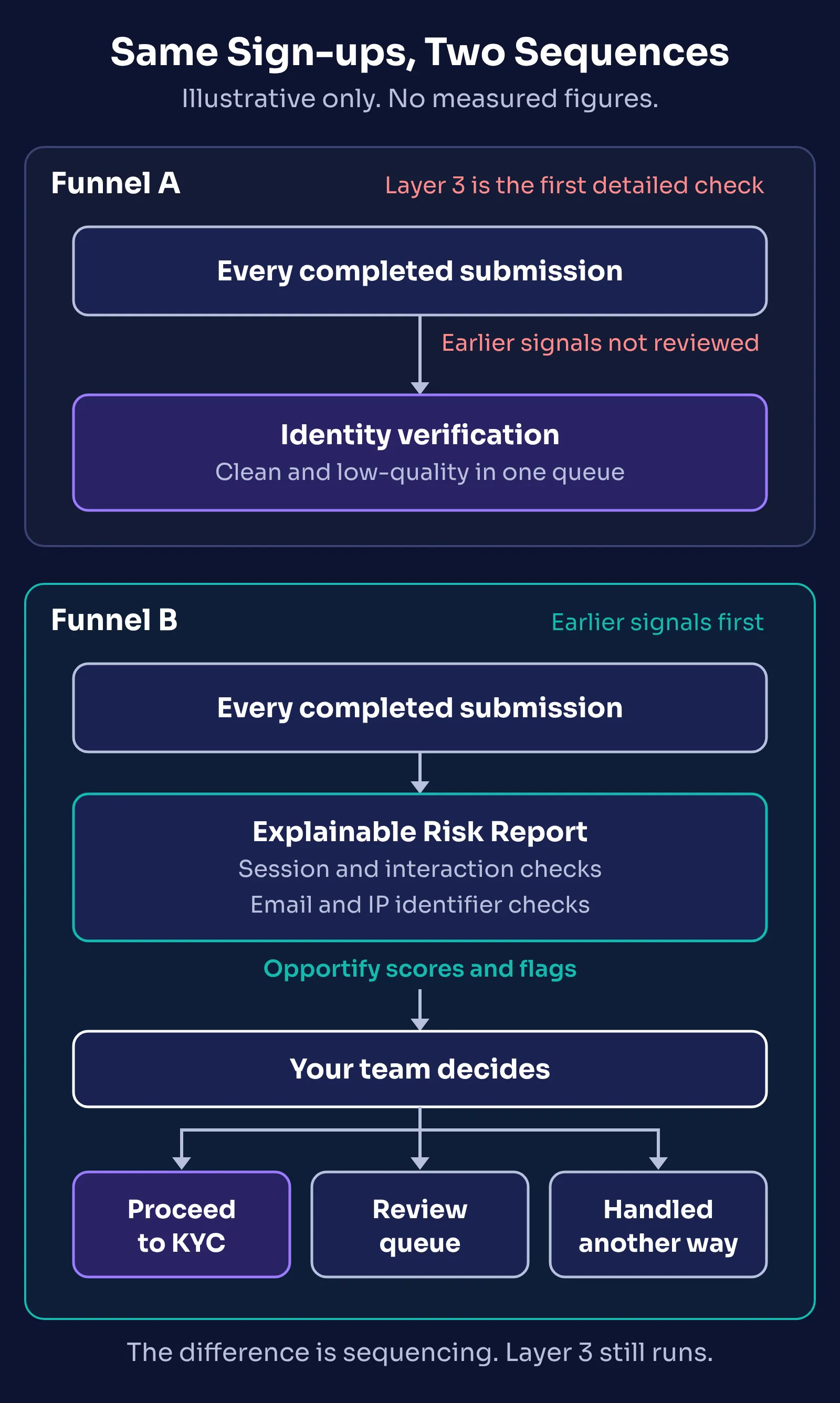
The difference is sequencing, not a promised reduction in verification volume. Layer 3 still runs where identity must be confirmed. Earlier layers give your team context so KYC is used for identity questions, not as the first filter for identifier or session risk that was already visible.
Opportify scores and flags those earlier signals. Your team decides what happens next.
How Layers 1 and 2 Reduce Layer 3 Load Without Replacing It
Opportify operates at Layers 1 and 2: Interaction and Session Intelligence combined with Input and Signal Intelligence. That coverage sits after traffic filtering and before identity verification. It is the pre-onboarding stage where fake leads, fake identities, and form abuse often enter a pipeline before anyone has asked for a document.
Fraud Protection combines behavioral session signals with identifier-level risk scoring and returns a normalized risk score from 200 to 1000, along with explainable signals. Those outputs are advisory. The decision on how to act remains with the business.
Standalone identifier products cover parts of Layer 2 today:
- Email Insights scores and enriches email addresses.
- IP Insights scores and enriches IP addresses.
- Phone Insights is coming soon.
Using Layers 1 and 2 well does not turn Opportify into a KYC vendor, and it does not replace document checks, liveness, face match, or watchlist screening. It gives your team a chance to review risk before those checks run. For the broader architecture, see Building a Multi-Signal Fraud Detection Stack. For why this gap opened in the first place, see The Rise of Pre-Onboarding Fraud and Detecting AI-Generated Email, IP, and Phone Identifiers.
A Practical Checklist for Risk Teams
When you evaluate a KYC workflow next to the layers that sit above it, these questions keep the jobs separate:
- Map the path to verification. Which sign-up, trial, and lead flows send every submission straight to identity verification with no earlier review?
- List the signals you already have. Which Layer 1 session or device signals, and which Layer 2 email, IP, or phone signals, are collected today?
- Write down how scores will be used. Decide how your team will treat advisory scores: proceed to KYC, send to a review queue, or handle the submission another way. A score is not an identity decision.
- Keep Layer 3 for identity questions. Use document checks, liveness, face match, and AML/PEP/sanctions screening to test who someone claims to be, not to discover for the first time that an identifier looked risky.
- Look upstream after a failure. When a KYC check fails, or when a later fraud event appears at Layer 4, ask which earlier layer could have surfaced the risk.
- Collect only what the flow needs. Ask for a phone number only when the flow genuinely needs one.
Key Takeaways
- Identifier Trust Layers is Opportify's original framework for mapping trust across the user lifecycle. It is not an industry standard.
- Layer 3, Identity Verification, typically includes document checks, liveness detection, face match, and AML/PEP/sanctions screening.
- That layer is designed to catch false identity claims, synthetic personas with real-looking documents, and matches against watchlists.
- Its blind spot is earlier-layer leakage. KYC does not retroactively clean data that entered the pipeline at Layer 1 or Layer 2.
- Opportify operates at Layers 1 and 2, before KYC. It is not a KYC vendor.
- Earlier layers score and flag risk. Your team decides how to use those signals, including whether a submission proceeds to KYC.
Continue to Layer 4: The Transaction Layer Catches Fraud Too Late.
Part of the Identifier Trust Layers series by Opportify. Previous: Layer 2: Input and Signal Intelligence. Also in this series: Layer 0: Traffic Filtering and Network Defense and Layer 1: Interaction and Session Intelligence.